homepage
Leave A Message
If you are interested in our products and want to know more details,please leave a message here,we will reply you as soon as we can.
submit
banner
Home

Blog

Blog

  • Is That Low Price Buying You a Product, or a Ticking Time Bomb?
    Is That Low Price Buying You a Product, or a Ticking Time Bomb?
    Apr 21, 2026
    "I remember a client back in 2023. They were searching for a reliable Nanocrystalline Core Manufacturer and found a supplier quoting 30% below the market average. They were thrilled, thinking they’d hit a gold mine of efficiency. Six months later, I got a frantic call. Their high-power inverters were failing in the field. The 'bargain' cores had lost 40% of their permeability in the field. It cost them their reputation with a Tier-1 automotive client. That’s when I told them: In this industry, if the price is that low, there are always Hidden Costs of Cheap Components."    After two decades in international trade—the last few specifically focused on the high-stakes world of magnetic components—I’ve seen this script play out a hundred times. We all want to optimize costs, but in technical manufacturing, there is a floor where "savings" transform into "systemic risk."   If you are currently Evaluating Magnetic Component Suppliers, here is the reality of what is often happening behind the scenes when a quote looks too good to be true:   1. Why CMC Cores Fail in the Field In the nanocrystalline and amorphous industry, quality is hidden in the heat treatment processing. To hit an impossible price point, some factories take shortcuts that compromise High-Frequency Core performance Stability: • The Single Annealing Shortcut: Proper magnetic stability requires precise, often multiple, magnetic field annealing steps. To save on electricity, some shops skip a cycle. The core looks fine during initial inspection, but its performance "falls off a cliff" after a year of application. • Recycled Scrap Material: Using lower-grade alloy ribbons slashes costs but introduces impurities. This is one of the leading Nanocrystalline Core Reliability Issues, leading to inconsistent flux density and higher core losses that eventually destroy your electronics.   2. The Financial "Shadow Games" Sometimes, a low price is a symptom of a supplier's desperate financial state. • Cash-Flow Traps: Some factories use low prices as bait to collect deposits quickly for high-interest lending. They delay payments to their own suppliers, creating a fragile chain that can collapse mid-order. • The Interest-Free Financing Scheme: They use your capital as a loan for six months and then claim they "cannot deliver." While you get your money back, your project deadlines have already gone up in flames.   3. The "One-Time" Business Model & Ethics Low-cost leaders often have no intention of a second deal. They may ship short quantities or ignore after-sales issues. Furthermore, when prices are extremely low, it’s crucial to vet the labor source. For companies in the West, Avoiding Procurement Fraud and unethical labor practices is not just about cost—it’s about protecting your brand from massive legal liabilities and customs seizures.   Summary for Procurement Managers When you see a price that defies logic, don't just look at the bottom line. Look at the annealing consistency and the factory's financial reputation. In the world of power electronics, the most expensive component is always the one that fails after it’s already been installed in your customer's system. Choose value, stability, and longevity over a temporary discount.
    Read More

  • Why "100% Payment Before Shipping" Isn't a Safety Net Anymore
    Why "100% Payment Before Shipping" Isn't a Safety Net Anymore
    Apr 01, 2026
    For over 20 years in foreign trade, I lived by one rule: Get the full payment, ship the goods, and the deal is closed. It was a simple, "safe" mindset that I shared with many peers. But the 2026 revisions to the Maritime Law have completely flipped that logic.   The Harsh Reality of the New Law As of May 1, 2026, the law is clear: If a buyer abandons cargo at the destination port or fails to pick it up, the Shipper (You) is legally responsible for all resulting costs—storage fees, terminal charges, and disposal costs. Essentially, even if you’ve been paid in full, you are still the ultimate guarantor for that cargo until it clears the port. If the buyer disappears, the shipping line and the port won't chase a "ghost" buyer overseas; they will come after the person they can find: The Shipper.   How JH is Adjusting Our Strategy: Rethinking FOB: We used to think FOB meant "load it on the ship and forget it." Now, we realize FOB gives away control but keeps the tail-end risk. We are becoming much more involved in tracking the final delivery. Strict Client Vetting: We no longer just chase orders. We look for partners with real operational history and physical infrastructure. A buyer with high "sunk costs" is a safe buyer. In the magnetic core industry today, being a "top seller" isn't enough. You have to be a "top survivor." At JH, we choose to prioritize a robust, closed-loop supply chain over quick, risky wins.    
    Read More
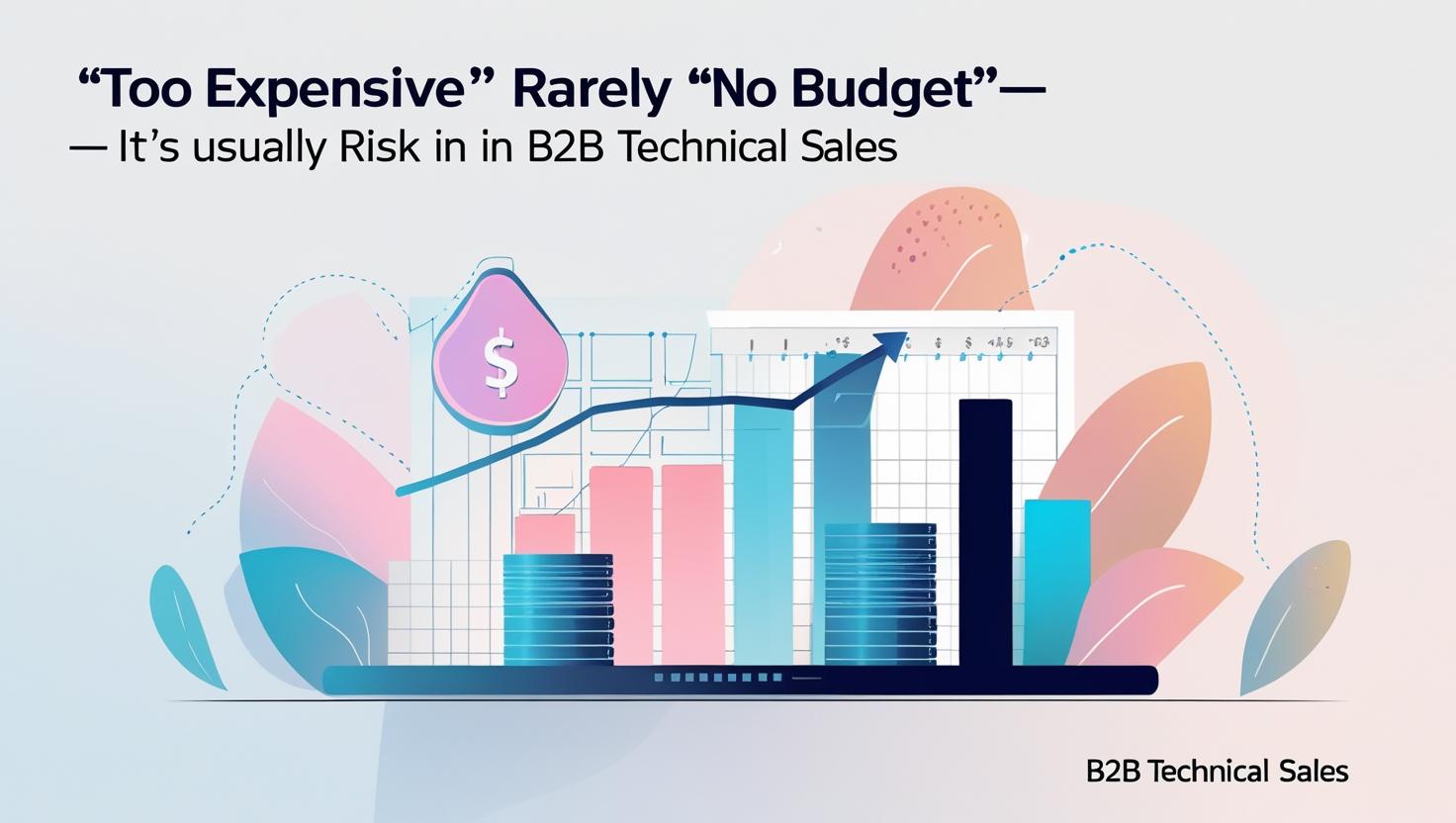
  • “Too Expensive” Rarely Means “No Budget” — It’s Usually About Risk in B2B Technical Sales
    “Too Expensive” Rarely Means “No Budget” — It’s Usually About Risk in B2B Technical Sales
    Jul 18, 2025
    In B2B technical sales, price objections often hide a deeper concern: performance risk. Learn how to turn uncertainty into confidence with engineering validation — and close high-value deals without discounts.   Why “Too Expensive” Often Means “Too Risky” In B2B technical sales, hearing “the price is too high” is common. But more often than not, the objection isn’t really about budget — it’s about risk perception. Customers dealing with high-stakes products — such as nanocrystalline cores, inverters, or EV components — need proof, not just a price tag. When performance is uncertain, even a competitive quote won’t secure the deal.   Case Study: Selling Nanocrystalline Cores to a Korean Inverter Manufacturer One of our prospects — a Korean inverter company — praised our nanocrystalline magnetic cores for their excellent technical performance. But their initial feedback was: “We love the performance. But the price is too high.” Rather than offer a cheaper product, we asked a strategic question: “Is the concern really cost — or whether the product’s performance will justify the investment?”   Root Cause: Uncertainty in Thermal Performance The client's engineering team admitted their real concern: they were unsure if our product would meet their thermal threshold in real-world use. This was a classic case of risk-based decision making.   Our Solution: Performance Validation Through Data Instead of discounting, we delivered engineering confidence: Thermal test reports showing performance under load; Fatigue testing data from an existing EV client; A pilot batch for in-system validation and custom testing. By addressing the root concern, we enabled the client to move forward without hesitation.   Result: Purchase Order Without Price Reduction 3 months later, we received the purchase order. What changed? Not our price — but the customer’s confidence in our solution. They needed clarity, not concessions.   Key Takeaway: Sell Confidence, Not Just Products In the world of EV components, inverter cores, and power electronics, your customers are not just evaluating your materials — they’re assessing whether they can trust your product in their mission-critical systems. The smartest way to overcome objections is to: Understand the real source of hesitation; Offer concrete, technical proof; Replace doubt with data. Dongguan JH Amorphous design and export nanocrystalline and amorphous magnetic cores to manufacturers in the EV, inverter, and transformer industries worldwide.Let’s engineer better performance — together.    
    Read More

leave a message

leave a message
If you are interested in our products and want to know more details,please leave a message here,we will reply you as soon as we can.
submit

home

products

WhatsApp

Contact