Sep 29, 2026
Why OEMs second-source nanocrystalline cores now
Many power and EMI designs in Japan, North America, and Europe were frozen around well-known nanocrystalline brands—often discussed in the same breath as VAC Vitroperm-class or Hitachi Metals Finemet-class materials. Those programs still need high-μ CMCs, stable AL, and predictable EMI. What changed is supply strategy: dual source, shorter sample loops, and China OEM capacity that can hit engineering windows when drawings are written tightly. Second-sourcing is not “buy the cheapest toroid labeled nanocrystalline.” It is locking the magnetic grade intent, test conditions, and change control so a China manufacturer can support—not quietly rewrite—your filter or inductor.
Dongguan JH Amorphous Co., Ltd. (www.amorphousoem.com) supplies OEM/ODM amorphous and nanocrystalline cores under ISO9001:2015 and IATF 16949. This article is a buyer/engineer checklist for second source and dual source programs aimed at service-sensitive markets (US, Canada, UK, France, Italy, Japan, and similar), not a price war playbook.
Buyer priority
What to freeze
What fails if you skip it
Role: CMC vs inductor
Grade family (high-μ CM vs energy-storage / lower-μ)
μ trap, wrong EMI or saturation behavior
Geometry
OD/ID/HT, case, gap mark, lead egress
Winding house scrap, harness EMI
AL / Z window
Test frequency, excitation, fixture notes
Lots that “pass OD” fail on the bench
Quality system
IATF scope, PPAP level, PCN rules
Quiet process drift after SOP
Validation
EMI/thermal delta vs incumbent sample
Field returns after dual-source swap
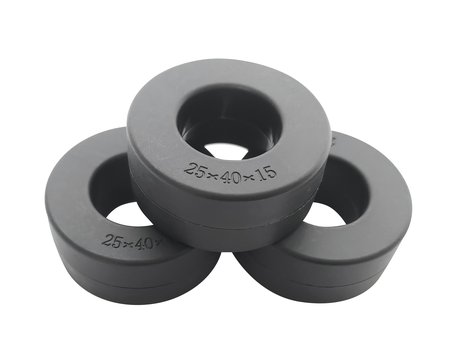
Plastic-cased toroids: second-source reviews start with magnetic role and AL windows.
VAC / Finemet-class language—without false equivalence
Purchasing often says “VAC alternative” or “Finemet equivalent.” Engineering should translate that into measurable targets: permeability class for CM vs DM duty, Bs and thermal story vs ferrite, core loss at your kHz, dimensional stack for the winding house, and insulation/coating system. Trademarked alloy families are not interchangeable by name. Treat them as performance neighborhoods you reverse-engineer into a drawing. Claim “same brand chemistry” only when your lab and legal teams have that evidence—most second-source programs instead prove fit-for-function on the finished CMC or inductor.
Useful framing for RFQs to China OEMs:
Application: CMC / PFC inductor / cut C-core / CT—not “nanocrystalline toroid.”
Incumbent sample available for AL correlation and EMI delta (preferred).
Target AL or impedance band at stated conditions; reject “typical μ” as the only spec.
Annual volume, sample lead time, and whether PPAP (or customer PPAP-like pack) is required.
Contact path to applications engineering, not only sales.
Related reading on the grade mistake that kills dual-source programs: the μ trap on nanocrystalline datasheets. For automotive paperwork depth, see IATF 16949 and PPAP for core suppliers.
What to put on the drawing before you dual-source
Magnetic role. High-μ closed-path grades for CM impedance are not the same anneal philosophy as gapped or lower-μ energy-storage cores. If the incumbent was a CMC, do not accept an “inductor-looking” nanocrystalline with a gap unless EMI and thermal are revalidated. Cut cores and fringing need their own keep-outs—see air-gap fringing and winding placement.
AL / impedance. State frequency, waveform notes, and fixture correlation. Keep a golden sample when the second source uses a different AL meter. Lot histograms beat single-point brochure numbers.
Mechanicals and insulation. Case resin, varnish, ceramic vs organic ribbon insulation, and edge condition affect hi-pot, thermal, and winding damage. Ask what changes trigger a PCN. Background: ceramic vs organic insulation questions for OEM buyers.
Thermal and EMI context. Ferrite may be discussed as soft near ~100–120°C; nanocrystalline alloy Curie is far higher (~570°C class), but finished assemblies still live inside copper and plastic limits (often discussed about -40°C to +140°C). Open magnetic paths and poor lead dress still fail EMC regardless of brand heritage—open-path EMI signatures and high-temperature magnetics.
Coated toroids across sizes: freeze the coating/insulation system when dual-sourcing an incumbent.
Validation that service-focused buyers actually run
Price-insensitive customers still hate requalification surprises. A practical second-source gate:
Dimensional FAIR against the frozen drawing.
AL / Z distribution on N pieces from the proposed production route.
Wound sample: copper rise, acoustics if relevant, and near-field or conducted EMI delta vs incumbent.
Thermal soak if ferrite was in the old path or ambient is hot.
Paper: certificate scope page, control-plan outline, material declarations, agreed PPAP level for automotive.
Field context from programs that already exercised nanocrystalline CMCs under real EMI/thermal pressure: German 800 V EMI case, Italian EV charger thermal/EMI case. Product examples to anchor RFQs: nanocrystalline cores for common mode chokes, cut C-cores for power magnetics, CMC selection guide.
Market cue
What they usually optimize
Supplier behavior that fits
US / CA / UK
Drawing discipline, English FAE, dual source risk
Clear AL windows, sample speed, PCN in writing
DE / FR / IT
EMC + automotive/industrial QMS
IATF-aware packs, EMI delta data
JP
Consistency, packaging, communication quality
Tight tolerances, lot codes, responsive FAE
Other high-spec OEMs
Second source without redesign
Incumbent correlation, not catalog guesswork
Oval / racetrack cores: lock window and build dimensions on the drawing, not just OD.
Case and base options: resin, lead egress, and mounting belong in the change-control plan.
Wound CMC assembly: prove fit-for-function with EMI and thermal delta against the incumbent.
FAQ
Q1: Can a China OEM replace a VAC- or Finemet-class core one-for-one?
Sometimes on geometry and AL windows, never by trademark name alone. Prove fit-for-function on the wound part and freeze grade intent on the drawing.
Q2: What is the fastest way to fail a second-source trial?
Ordering by OD and “nanocrystalline” without CMC vs inductor grade, AL test conditions, or EMI delta against the incumbent.
Q3: Do we need full PPAP for every dual-source core?
Automotive serial parts usually yes at the agreed level; industrial programs still need a defined approval pack and PCN rules. Details: IATF/PPAP guide.
Q4: Should we dual-source different anneal philosophies?
Not without full requalification. Two routes that only share OD are two different parts electrically.
Q5: Who should own the RFQ—purchasing or engineering?
Both. Purchasing owns commercial dual-source risk; engineering owns magnetic role, AL, and EMI. JH Amorphous expects joint reviews so piece price does not reopen EMC.
For second-source or dual-source nanocrystalline / amorphous core reviews (drawing check, AL correlation, sample planning), contact julia@amorphousoem.com — www.amorphousoem.com.
Read More


 Room 701, Jizhou Tongde Street 45, Shijie Town, Dongguan City, Guangdong Province, China
 +86-180 2701 0075
 sales@amorphousoem.com


 IPv6 network supported |
Sitemap
|
XML
|
blogs
|
Privacy Policy
IPv6 network supported |
Sitemap
|
XML
|
blogs
|
Privacy Policy