Sep 30, 2026
Ferrite and nanocrystalline are not drop-in twins
If you design EMI filters or power magnetics for industrial, EV, or server-class PSUs, you have lived this choice: MnZn/NiZn ferrite on one side of the bench, iron-based nanocrystalline ribbon cores on the other. Brochure tables make the swap look obvious—higher Bs, higher μ, “better EMI.” On a real CMC or inductor drawing, the materials behave differently under bias, temperature soak, and AL fixture correlation. That gap is exactly where dual-source programs either land cleanly or reopen EMC after SOP.
This article is written for high-spec buyers in JP, CA, US, FR, UK, IT, RU, and similar markets who already ran VAC Vitroperm-class or Hitachi Metals Finemet-class nanocrystalline programs and now need a China OEM as engineering second source—not a cheap catalog substitute. Dongguan JH Amorphous Co., Ltd. (www.amorphousoem.com) supplies OEM/ODM amorphous and nanocrystalline cores under ISO9001:2015 and IATF 16949. We help freeze grade intent, AL/Z windows, and change control so a second source supports your filter, not quietly rewrites it.
What each material actually is (in magnetics terms)
Ferrite is a sintered ceramic (iron oxide plus Mn/Zn or Ni/Zn oxides). High resistivity keeps eddy currents low; shapes are moldable (toroids, E/U cores, beads). MnZn grades are the usual workhorse for power and mid-band EMI; NiZn typically pushes higher frequency at the cost of lower μ. Saturation flux density for common MnZn CMC grades sits roughly in the ~0.3–0.5 T neighborhood. Curie temperatures are relatively low, so permeability and loss can move hard as the hotspot approaches ~100–120°C—see high-temperature magnetics when ferrite derates.
Nanocrystalline starts as rapidly solidified Fe-Si-B-Nb-Cu (and related) amorphous ribbon, then anneals into ~10–20 nm grains. Finished cores are usually cased or coated toroids / cut cores. Typical iron-based grades used in CMCs offer Bs around ~1.2–1.25 T class, very high initial permeability (often discussed as tens of thousands to >80,000 depending on grade and test conditions), low magnetostriction, and alloy Curie near ~570°C. The finished assembly still lives inside copper enamel, case polymer, and varnish limits—often discussed about -40°C to +140°C for the wound part. High-μ CMC grades and lower-μ energy-storage / inductor-oriented finishes are different anneal philosophies; mixing them by OD alone is the classic μ trap.
Coated ribbon cores — finish and insulation belong on the drawing with grade, not as an afterthought.
Comparison table: EMI / CMC / power magnetics tradeoffs
Numbers below are order-of-magnitude engineering neighborhoods for discussion—always lock AL or impedance at your frequency, excitation, and fixture. Do not treat trademark alloy families as interchangeable by name; when buyers say “VAC/Finemet-class,” translate into measurable windows on the drawing.
Property / decision
Ferrite (typical MnZn CMC / power)
Iron-based nanocrystalline (CMC-class)
Composition
Ceramic oxide (MnZn / NiZn)
Metallic ribbon alloy (Fe-Si-B-Nb-Cu class), annealed
Bs (order)
~0.3–0.5 T
~1.2–1.25 T class
Initial μ (order)
~1,500–15,000 (grade-dependent)
Very high (often >> ferrite; grade & test condition driven)
Useful EMI band (CMC practice)
Strong mid–high MHz; NiZn for HF beads
Strong from tens of kHz into several MHz; broadband CM impedance
Thermal / Curie story
Softens near ~100–120°C hotspot class
Alloy Curie ~570°C; assembly limited by Cu/case (~-40 to +140°C class)
Core loss / size
Higher loss → larger stack for same EMI/thermal
Lower loss, fewer turns, smaller volume for high-current CM
Mechanics
Brittle ceramic; moldable shapes
Thin ribbon; needs case/varnish; winding stress matters
Relative piece cost
Usually lower
Higher unit price; often lower system EMI/thermal cost
When it wins
Modest current, cool ambient, HF-only noise, cost-sensitive SMPS
High CM current, low-frequency EMI, hot EMI soaks, size-constrained OBC/inverter
For choke sizing practice—AL, OD/ID/HT, casing, and impedance bands—use the common mode choke selection guide. Product-family context for wound CMC cores: nanocrystalline common mode choke cores.
Cased nanocrystalline CMC cores — high Bs and high-μ grades for low-frequency / high-current common-mode stages.
When ferrite still wins
Nanocrystalline is not a blanket upgrade. Ferrite remains the right call when:
Noise is high-frequency and current is modest. NiZn beads and small MnZn CMCs often cover MHz-range conducted/radiated issues without paying for high Bs.
Hotspot stays cool. If thermal mapping shows the core well below the ferrite soft region, μ collapse is not your limiter—copper or layout may be.
Shape and gap freedom matter more than Bs. Complex E/U geometries, adjustable gaps, and multi-gap stacks are mature in ferrite tooling.
Cascade filters already mix materials. Many industrial EMI stages use ferrite on the HF end and nanocrystalline on the low-frequency / high-current CM stage. Replacing both with one alloy because of a brochure is rarely optimal.
Cost-only consumer SMPS with loose EMI margin where requalification risk is low and ambient is gentle.
Related material discussion: how core materials define CMC performance.
When nanocrystalline (VAC / Finemet-class performance neighborhood) wins
Use nanocrystalline when the failure mode is saturation under CM surge / bias, insufficient impedance below a few hundred kHz, or EMI that collapses after a hot soak on ferrite. Typical contexts: EV onboard chargers and DC-DC front-ends, high-power industrial inverters, compact UPS/server PSUs, and multi-frequency noise where fewer turns and higher Bs shrink the filter. Bs headroom (~1.25 T class vs ~0.4 T ferrite) lets you hold inductance under peak current that would drive ferrite soft.
Language discipline for RFQs: say VAC/Finemet-class or comparable grade when you mean a performance neighborhood (high-μ CM vs inductor finish, Bs/thermal story, AL window). Do not claim trademark equivalence or identical chemistry unless your lab and legal teams have that evidence. Most dual-source programs prove fit-for-function on the wound CMC or inductor against an incumbent sample. Checklist depth: second-sourcing nanocrystalline cores—what VAC/Finemet-class buyers should freeze.
Saturation, permeability, and thermal—what actually breaks EMI
Saturation. Ferrite’s lower Bs means CM surge or DC bias collapses μ earlier; the choke looks fine at light load and fails under load dump or motor start. Nanocrystalline delays that collapse, but an open magnetic path, poor lead dress, or wrong AL still fails EMC. Geometry mistakes are not fixed by alloy brand heritage.
Permeability. Very high μ gives high CM impedance with fewer turns (lower copper loss), yet it is also easier to mis-apply: a high-μ CMC core pressed into gapped energy-storage duty, or an inductor-oriented grade sold into a CM filter, both look “nanocrystalline” on the PO and wrong on the spectrum analyzer. Freeze magnetic role on the drawing.
Thermal. Ferrite derating near ~100–120°C is a magnetic story. Nanocrystalline’s high Curie is an alloy story; the wound choke still dies from enamel, case continuous-use temperature, or copper resistivity rise. Map hotspots, then decide whether μ/Bs collapse or assembly limits dominate. Insulation and casing choices belong in the same review as grade—ceramic vs organic ribbon insulation. Gapped inductor builds need winding keep-outs from fringe fields—air-gap fringing and winding placement.
Second-source drawing freeze notes (before you switch materials or suppliers)
Whether you move ferrite → nanocrystalline or dual-source a Finemet-/Vitroperm-class incumbent to a China OEM, freeze these items before samples leave the plant:
Role: CMC (closed-path high-μ) vs inductor / PFC (gapped or lower-μ) vs CT—not “nanocrystalline toroid.”
AL or Z window at stated frequency, excitation, and fixture notes; keep a golden sample for meter correlation.
Geometry stack: OD/ID/HT, case type, gap mark, lead egress for the winding house.
Insulation / coating / varnish system and what triggers a PCN.
Thermal & EMI validation: wound-sample delta vs incumbent (conducted/near-field as applicable) after soak.
QMS path: IATF scope when automotive, agreed PPAP level, change control—see IATF 16949 and PPAP for magnetic core suppliers.
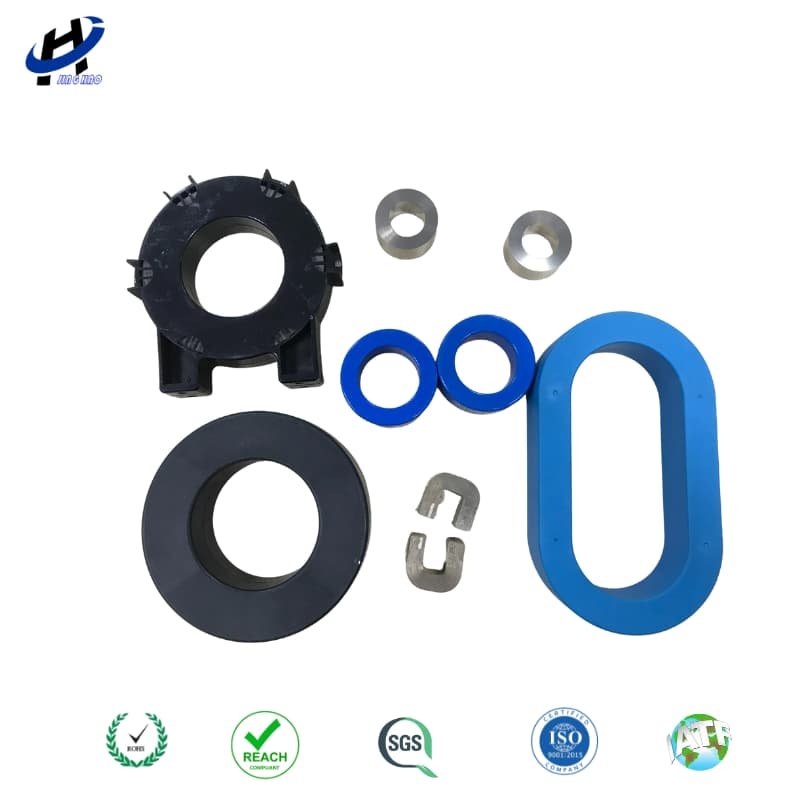
OEM core assortment — freeze role (CMC vs CT vs inductor) before OD alone drives the PO.
Service-over-price buyers optimize requalification risk and field EMI, not piece price alone. A China second source that hits frozen AL histograms and PCN discipline is an engineering partner; a low quote that only matches OD is a future EMC reopen.
Practical decision path
List noise band, I_rms / I_peak CM, ambient and hotspot budget.
If ferrite EMI fails after thermal soak or under surge—shortlist nanocrystalline CMC-class cores.
If noise is HF-only and current/temperature are gentle—keep ferrite or cascade both.
Size AL/Z and copper; verify on the wound part, not brochure μ.
For dual source after VAC/Finemet-class history: freeze the drawing list above, then correlate samples.
FAQ
Q1: Can I drop a nanocrystalline toroid into a ferrite CMC footprint one-for-one?
Sometimes on OD/ID/HT, rarely on electrical behavior without revalidating turns, AL, leakage, and EMI. Treat it as a design review, not a catalog swap.
Q2: Is nanocrystalline always better for EMI?
No. It usually wins on high-current / low-frequency CM and thermal stability of the magnetic function. Ferrite can still win at HF with modest current, or in cascade stages.
Q3: What does “VAC/Finemet-class” mean in an RFQ to a China OEM?
A performance neighborhood and incumbent correlation target—not a claim of trademark identity. Specify role, AL/Z conditions, geometry, insulation, and EMI/thermal delta expectations.
Q4: Why did my ferrite CMC pass cold and fail after soak?
μ and loss often move as ferrite approaches its soft thermal region (~100–120°C class). Re-map hotspot; consider nanocrystalline if magnetic derating is the limiter.
Q5: What should purchasing and engineering freeze together?
Grade intent (CMC vs inductor), AL/Z window with test notes, mechanical stack, insulation/PCN rules, and validation against the incumbent. Price alone should not reopen EMC.
For ferrite-to-nanocrystalline reviews or VAC/Finemet-class second-source drawing checks (AL correlation, sample planning, CMC grade selection), contact julia@amorphousoem.com — www.amorphousoem.com.
Read More


 Room 701, Jizhou Tongde Street 45, Shijie Town, Dongguan City, Guangdong Province, China
 +86-180 2701 0075
 sales@amorphousoem.com


 IPv6 network supported |
Sitemap
|
XML
|
blogs
|
Privacy Policy
IPv6 network supported |
Sitemap
|
XML
|
blogs
|
Privacy Policy