
Leave A Message
If you are interested in our products and want to know more details,please leave a message here,we will reply you as soon as we can.


Amorphous vs Nanocrystalline for Distribution and Medium-Frequency Transformers: Loss, Noise, and What to Specify
Buyers often ask for “amorphous or nanocrystalline for the transformer” as if one alloy wins every power stage. Distribution and industrial line-frequency transformers care about no-load loss, audible noise, and decades of grid duty. Medium-frequency (MF) transformers inside inverters, UPS, induction heating, and SST-like isolation stages care about loss density at tens of kHz, volt-second headroom, and packaging. Iron-based amorphous and nanocrystalline both beat classical silicon steel in the right band—but they are not interchangeable by Bs brochure alone.
This guide is written for high-spec OEM and energy buyers in JP, CA, US, FR, UK, IT, RU, and similar markets who need a China engineering second source that can hit frozen loss and geometry windows—not the cheapest ribbon label. Dongguan JH Amorphous Co., Ltd. (www.amorphousoem.com) manufactures OEM/ODM amorphous and nanocrystalline cores under ISO9001:2015 and IATF 16949. Starting points: amorphous cores for power transformers and inductors and nanocrystalline cut C-cores for power magnetics.
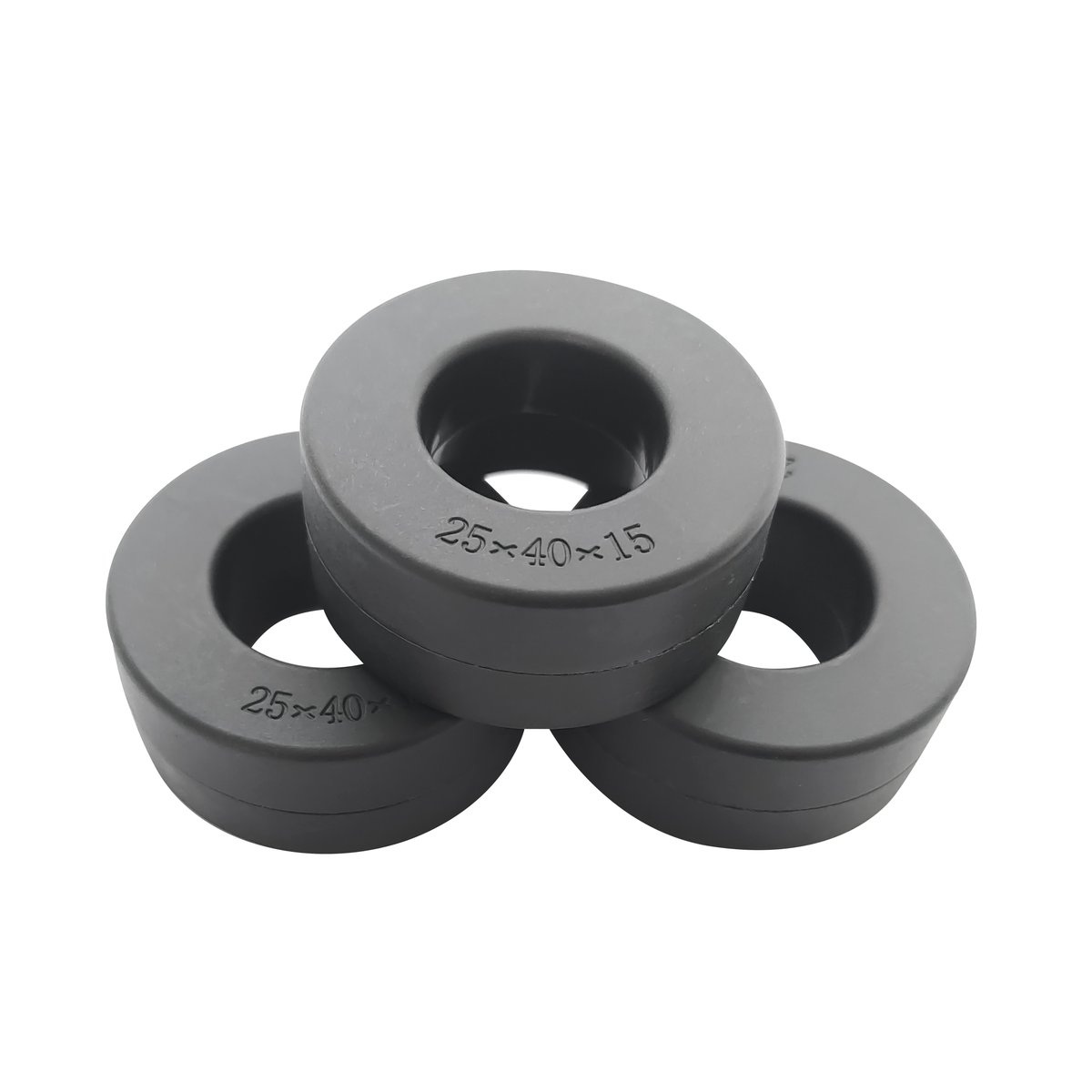
Cased cores — material grade and loss class must match line-freq vs MF duty.
Fe-based amorphous ribbon is rapidly solidified into a non-crystalline structure. Typical conversations cite Bs around ~1.56 T class, Curie near ~410°C, resistivity on the order of ~130 μΩ·cm, and strong no-load loss reduction versus silicon steel in 50/60 Hz distribution duty. Finished assemblies still live inside varnish, clamps, and tank oil or dry insulation limits. Amorphous is widely discussed for distribution transformer cores and for inductors/reactors into the low-to-mid kHz band depending on design.
Iron-based nanocrystalline starts amorphous, then anneals into ~10–20 nm grains. Typical HF/MF power grades discuss Bs ~1.2–1.25 T class, Curie near ~570°C, very low loss at elevated frequency, and finished-case windows often about -40°C to +140°C. Nanocrystalline shines when frequency rises and silicon steel (or even amorphous at the upper edge) becomes a heater. It is also the usual neighborhood for VAC/Finemet-class second-source discussions on EMI and power magnetics—always as a performance target, not a trademark claim. See second-sourcing nanocrystalline cores.
| Topic | Amorphous (typical) | Nanocrystalline (typical) |
|---|---|---|
| Bs (order) | ~1.56 T class | ~1.2–1.25 T class |
| Curie (order) | ~410°C class | ~570°C class |
| Sweet spot | 50/60 Hz distribution; low–mid kHz reactors/inductors | Medium/high-frequency transformers; compact HF power |
| Loss story | Excellent no-load vs silicon steel at line frequency | Excellent loss density as f rises into tens of kHz |
| Noise / magnetostriction | Often discussed; clamp/tank design critical for audible specs | Low magnetostriction grades help; still verify light-load tones |
| Geometry habit | Wound cores, cut cores, large stacks for distribution | Toroids and precision cut C/rectangular stacks for MF |
| Buyer freeze | No-load loss, noise, stacking, impregnation/PCN | Loss at f_sw, ΔB, gap/AL, fringe keep-outs |
Numbers are engineering neighborhoods for discussion. Lock loss and AL at your frequency, waveform, and temperature. Do not pick from a CMC high-μ row when the part is a power transformer—datasheet μ trap.
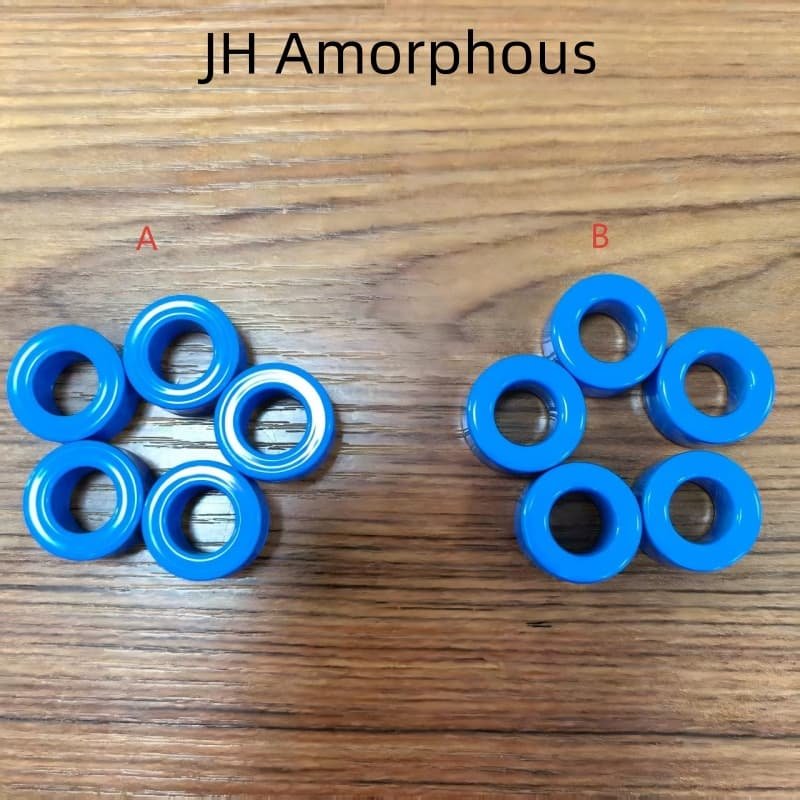
Coating/insulation systems — PCN triggers with grade, not after SOP.
At 50/60 Hz, no-load loss dominates lifetime energy cost for many utility and industrial distribution units. Amorphous cores are widely chosen because core loss can drop dramatically versus conventional silicon steel, cutting idle heat and improving efficiency labels. Higher Bs than nanocrystalline (~1.56 T vs ~1.25 T class) also helps ampere-turn and size conversations at line frequency. The engineering work shifts to stacking factor, joint design, impregnation, tank or dry-type cooling, and especially audible noise: magnetostriction and mechanical resonance can make a low-loss core fail a municipal or building acoustic limit if clamps and damping are weak.
RFQ items that matter more than “amorphous ribbon”:
As soon as the isolation or power stage moves into the kHz–tens of kHz band, loss density and size usually favor nanocrystalline (or carefully selected amorphous grades at the lower end of that band). Silicon steel becomes impractical; ferrite may lack Bs headroom for dense power; amorphous remains useful in defined bands but nanocrystalline is the common compact choice for HF transformers in solar inverters, UPS, welding supplies, induction heating PSUs, and MF isolation in SST-like architectures. Role mapping for SST stages: SST magnetic components explained.
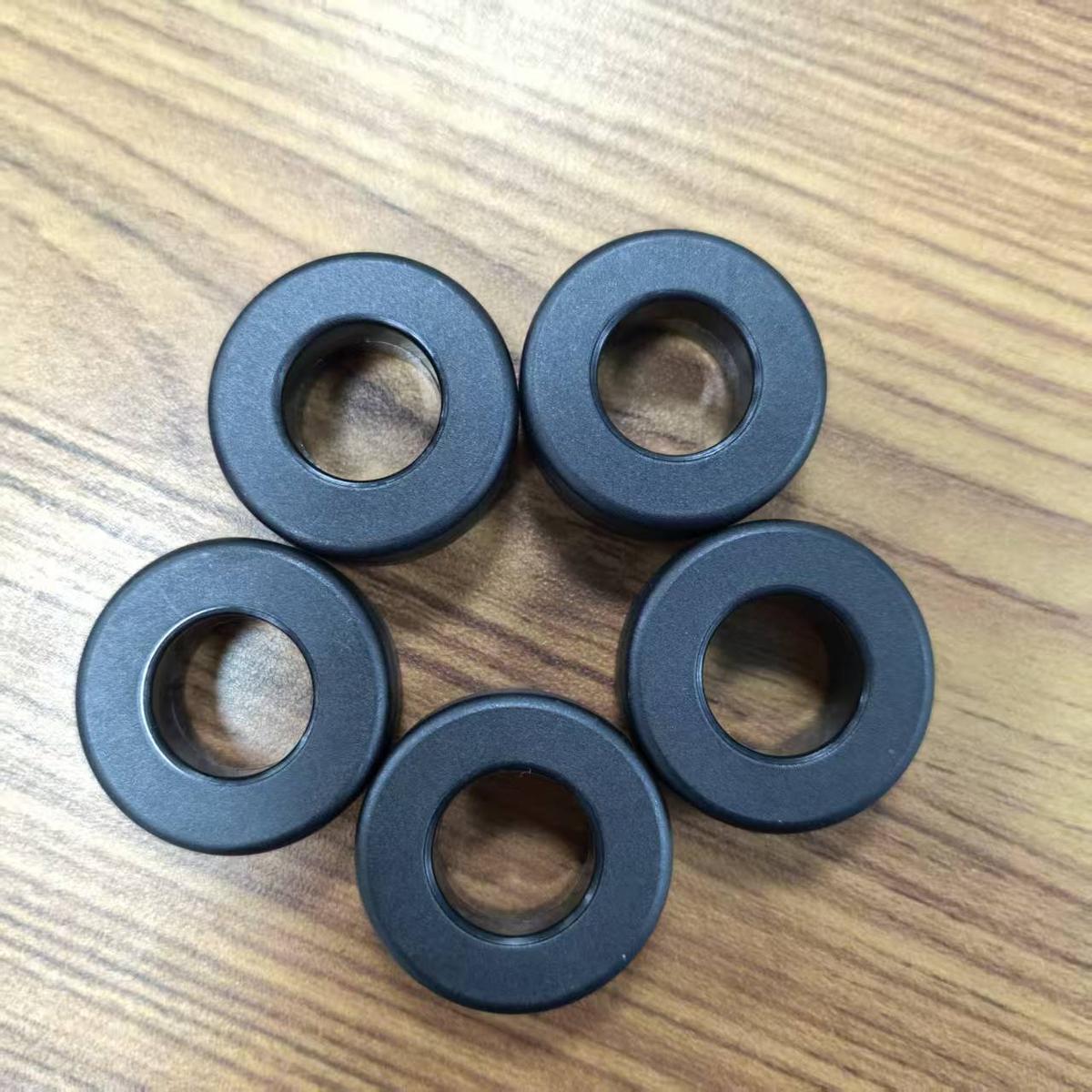
Case line continuity — geometry and AL windows for second-source correlation.
MF-specific freezes:
If the old design was ferrite and hot EMI or saturation forced a rethink, compare materials carefully—ferrite vs nanocrystalline for EMI/CMC and related freezes (different role, same drawing discipline).
Loss. Optimizing piece price while missing no-load guarantees (distribution) or hot-spot rise at f_sw (MF) is how programs reopen after type tests. Ask for loss under stated B and f, with sample correlation if dual-sourcing.
Noise. Magnetostriction-driven vibration is a system property: flux density, waveform harmonics, clamp stiffness, tank/enclosure coupling. Nanocrystalline’s low magnetostriction reputation helps many MF builds; amorphous distribution cores still need acoustic engineering. Related power-magnetics acoustics thinking: why power inductors whistle (different component, same magneto-mechanical diagnosis habit).
Wrong grade. Shipping a high-μ CMC anneal into an MF power transformer, or a distribution amorphous stack into a 40 kHz isolation stage without loss data, both look “soft magnetic” on the PO and wrong on the thermal camera.
Power assortment reference: nanocrystalline cores for power applications.
Many energy and industrial platforms mix a line-frequency amorphous distribution or auxiliary transformer with nanocrystalline MF isolation and nanocrystalline CMCs on the same cabinet. Purchasing shortcuts that tag every soft-magnetic line as “nano” or every cut core as “amorphous” create warehouse mix-ups that only show up in type tests. Tag each BOM line with role, alloy family, and geometry. Dual-source each family against its own incumbent sample and loss window.
For China OEM RFQs after VAC/Finemet-class history on the nanocrystalline MF side, keep trademark-free language: performance neighborhood, AL/loss conditions, and fit-for-function proof. Amorphous distribution second source needs the same discipline on no-load and noise—different metrics, same change-control habit.
Q1: Is nanocrystalline always better than amorphous for transformers?
No. Amorphous often wins distribution no-load and cost/performance at line frequency. Nanocrystalline often wins compact MF/HF transformers. Frequency and loss limits decide.
Q2: Can I use the same core drawing for 50 Hz and 20 kHz?
Almost never without a full redesign. Loss density, insulation, and cooling change with frequency even if Ae looks similar.
Q3: Why does my low-loss amorphous distribution unit still fail noise?
Loss and sound are coupled but not identical. Clamp, joint, flux density, and enclosure radiation dominate acoustics—treat noise as a system requirement on the RFQ.
Q4: What should a China OEM receive for a dual-source MF transformer core?
Role, frequency/waveform, loss or temperature-rise targets, geometry/gap, insulation/PCN rules, and an incumbent sample when possible. Trademark names alone are not a specification.
Q5: Do EMI ferrite lessons apply here?
The physics differ (power transformer vs CMC), but drawing discipline is the same: freeze role, test conditions, and change control before swapping materials or suppliers.
For amorphous or nanocrystalline transformer-core selection (distribution loss/noise or MF isolation density), contact julia@amorphousoem.com — www.amorphousoem.com.
 Room 701, Jizhou Tongde Street 45, Shijie Town, Dongguan City, Guangdong Province, China
 +86-180 2701 0075
 sales@amorphousoem.com


 IPv6 network supported |
Sitemap
|
XML
|
blogs
|
Privacy Policy