
Leave A Message
If you are interested in our products and want to know more details,please leave a message here,we will reply you as soon as we can.

Why Your Power Inductor Whistles: Magnetostriction vs Thermal Noise in Soft Magnetic Cores
A power inductor “whistle” is usually audible magnetostriction or mechanical vibration driven by magnetizing force at audio-band frequencies—not random thermal hiss. Soft magnetic cores strain slightly with flux (magnetostriction). If drive frequency, harmonics, or beat notes fall near 2–20 kHz, the assembly radiates sound. Thermal effects change expansion and varnish damping; they rarely create a pure tone alone. Fix the root: reduce ΔB in the audio band, avoid discontinuous magnetizing patterns that create tones, damp the mechanical stack, and select inductor-oriented grades (nanocrystalline or amorphous) with noise and loss in mind—not only AL and Bs.
Field returns that say “the magnetics sing” mix several mechanisms:
| Symptom | Likely dominant cause | First checks |
|---|---|---|
| Pure tone tracking f_sw or f_sw/N | Magnetostriction / magnetic force | ΔB, DCM/CCM boundary, burst mode |
| Tone at 100/120 Hz or multiples | Line-frequency magnetics / Lorentz | Rectifier ripple, mounting, clamps |
| Rattle changing with tap test | Loose mechanical stack | Gap filler, varnish, clip torque |
| Broadband hiss, no loud tone | Electrical noise / EMI path | Not a core whistle problem |
Replacing a core “because it is noisy” without checking excitation frequency and mounting often moves the tone instead of removing it.
Physics that matters for buyers: sound power scales with flux swing and mechanical coupling, not with μ alone. Burst-mode, skip-cycle, and light-load regimes often push energy into audible bands even when full-load operation is quiet. Gapped inductors add fringing; fringing increases local copper force and vibration paths next to the gap. Case, epoxy, and mounting can damp or amplify.
Iron-based nanocrystalline materials offer Bs ≈ 1.25 T and usable temperature windows that support compact designs. Compactness raises ΔB if turns and Ae are pushed hard. Noise control belongs in the magnetic design review, not only in the enclosure review.
| Factor | Mn-Zn ferrite | Amorphous | Nanocrystalline |
|---|---|---|---|
| Bs (typical order) | ~0.4 T | High (alloy-dependent) | ~1.25 T |
| Audible risk driver | ΔB & burst modes | Magnetostriction + mounting | Magnetostriction + high ΔB if over-miniaturized |
| High-temp hold | Derates near ~100–120°C class | Application-dependent | Curie ~570°C; finished cases often −40 to +140°C |
| Design lever | Lower ΔB, avoid burst tones | Damping, grade, impregnation | Grade/finishing, ΔB, impregnation, mount |
No material is always silent. Excitation and mechanics dominate.
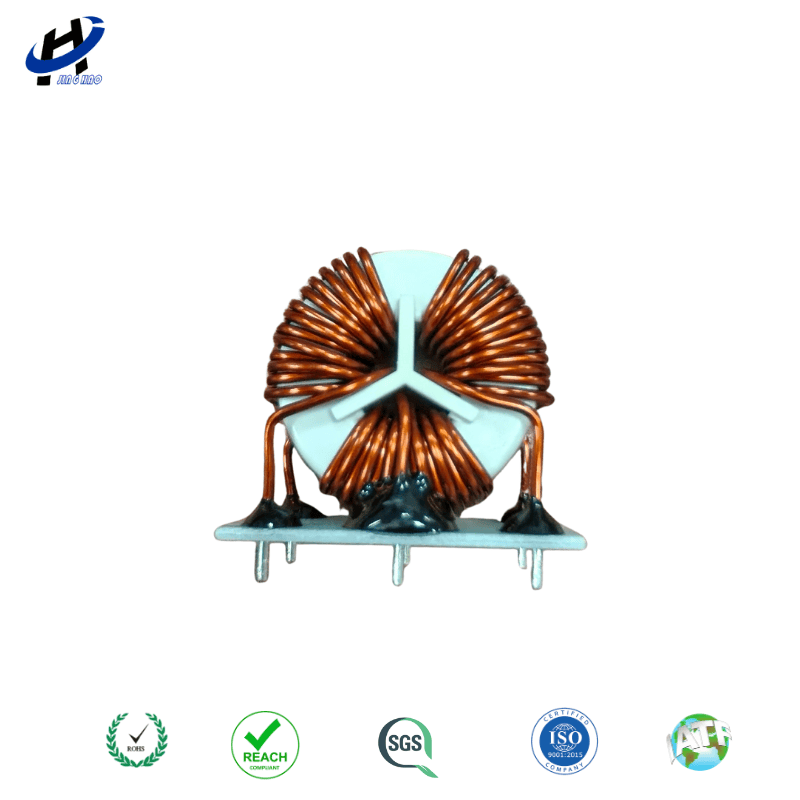
Copper on a toroid can couple magnetostriction into audible vibration—diagnose before you change the core chemistry.
“Thermal noise” in electronics usually means Johnson noise—irrelevant to a whistling choke on a bench. What people often mean:
Those modulate an existing magneto-mechanical drive. They do not replace magnetostriction as the tone generator.
Cold start: stiff varnish, higher mechanical Q → sharper tone possible. Warm operation: damping may rise or fall with the resin system. Hot spot near a gap: local copper expansion and force concentration. Automotive cold (−40°C class) vs under-hood heat: mount stiffness changes. Spec acoustic checks at min, typical, and max temperature—not only at 25°C lab air.
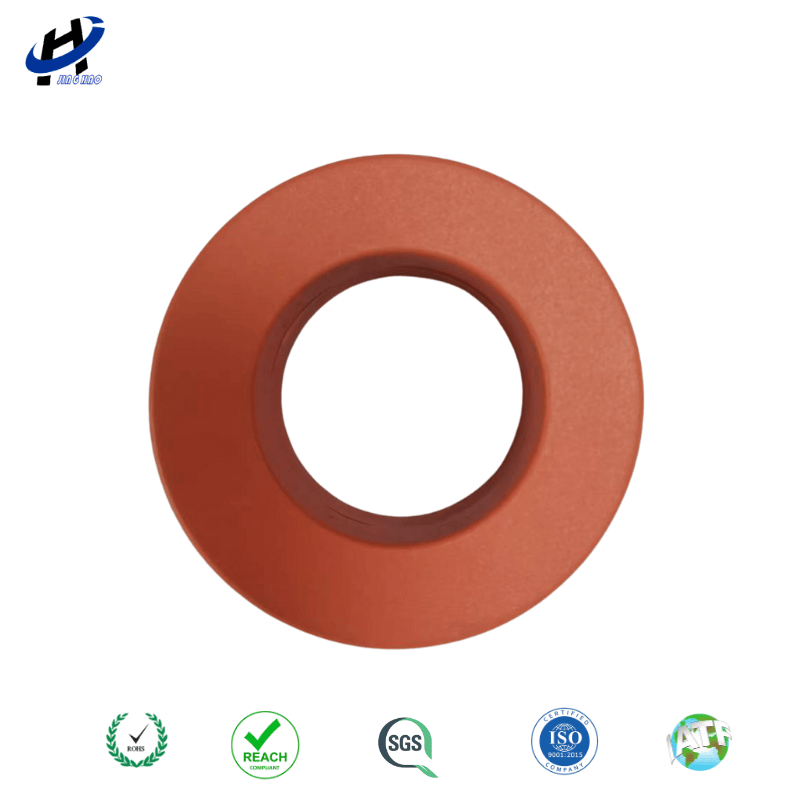
Coated power-inductor toroid: coating and case stiffness change how vibration reaches the PCB.
Magnetic excitation: Prefer continuous conduction strategies that avoid audio-band burst patterns when product requirements allow. Reduce ΔB with more turns, larger Ae, or lower voltage-second product. Spread spectrum or shift frequencies out of peak ear sensitivity only when EMI and control allow—then revalidate EMC. Avoid operating near saturation corners where magnetizing-current distortion creates strong harmonics. Select inductor-oriented grades (controlled effective μ under bias)—not a high-μ CMC core pressed into energy-storage duty (μ trap explained).
Core finishing and mechanics: Discuss impregnation, varnish, and case damping with your core OEM. For gapped parts, treat the gap region as both a thermal and acoustic hotspot—see also air-gap fringing loss and winding placement. Use rigid, damped mounting; avoid cantilevered heavy magnetics. Potting can damp vibration but may raise thermal resistance—validate both.
Lab sequence: Capture inductor current and a microphone channel on the same DAQ. Sweep load from no-load to full, including firmware modes sales demos never show. Note core-case and winding temperatures. Repeat with a soft pad under the board to separate structure-borne contribution. Change one magnetic variable at a time (gap, turns, grade, varnish).
EV charger light-load night charging and server acoustic contracts are common failure contexts: burst PFC or LLC skip modes create household-audible tones even when full-load EMI passes. Ask for light-load acoustic acceptance in the DV plan. Dongguan JH Amorphous supports OEM/ODM nanocrystalline and amorphous cores under ISO9001:2015 and IATF 16949. We do not promise a universal silent alloy; we match grade, AL under bias, and finishing to your excitation and mounting reality.
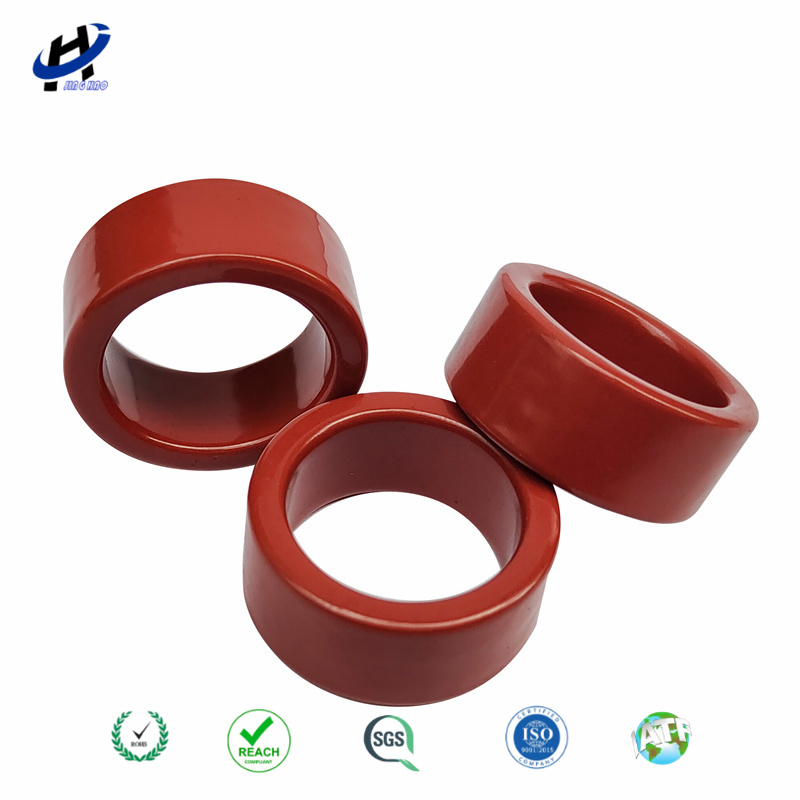
Epoxy-coated nanocrystalline rings used in inductor and CMC builds where acoustic limits matter.
No. Core loss is energy dissipated as heat from hysteresis and eddy currents. Magnetostriction is strain. They can correlate with excitation, but fixing loss does not automatically fix sound.
Not necessarily. Higher μ may reduce turns for a target L at low bias, but a CMC-oriented high-μ grade used as a power inductor can worsen harmonics via saturation. Match grade to inductor duty.
Almost never. A loud pure tone is magneto-mechanical or mechanical. Thermal noise is broadband and tiny.
State max SPL or “no audible tone at 1 m in quiet room” across load/temperature, list firmware modes, and request inductor-grade cores with impregnation options—not only OD and AL.
If a prototype inductor is whistling and you want a second look at grade and excitation, send I_L / V notes to julia@amorphousoem.com — www.amorphousoem.com.
 Room 701, Jizhou Tongde Street 45, Shijie Town, Dongguan City, Guangdong Province, China
 +86-180 2701 0075
 sales@amorphousoem.com


 IPv6 network supported |
Sitemap
|
XML
|
blogs
|
Privacy Policy
IPv6 network supported |
Sitemap
|
XML
|
blogs
|
Privacy Policy