
Leave A Message
If you are interested in our products and want to know more details,please leave a message here,we will reply you as soon as we can.

Oval and Racetrack Nanocrystalline CMC Cores for Space-Constrained EMI: What to Freeze on the Drawing
Common-mode choke design often starts on a round nanocrystalline toroid—and then the mechanical envelope says no. Dual busbars, overmolded Y-cap modules, flat cable exits, and low-profile OBC/DC-DC trays force the magnetic window into an oval, racetrack, or elliptical outline. The alloy may stay high-μ nanocrystalline CMC-class; the geometry becomes a packaging and winding problem. If purchasing only freezes “OD equivalent,” the second-source core will not seat in the mold, the AL histogram will miss, and EMC that passed on a round prototype will reopen on the production busbar.
This article targets service-over-price OEMs in JP, CA, US, FR, UK, IT, RU, and similar markets who need China nanocrystalline CMC capacity as an engineering drop-in for space-constrained filters—not a cheap round substitute forced into an oval cavity. Dongguan JH Amorphous Co., Ltd. (www.amorphousoem.com) supplies OEM/ODM nanocrystalline CMC cores under ISO9001:2015 and IATF 16949, including custom oval/racetrack builds. Field context: oval nanocrystalline core in automotive busbar / Y-cap modules. Product starting points: nanocrystalline CMC cores and nanocrystalline cores for EV applications.
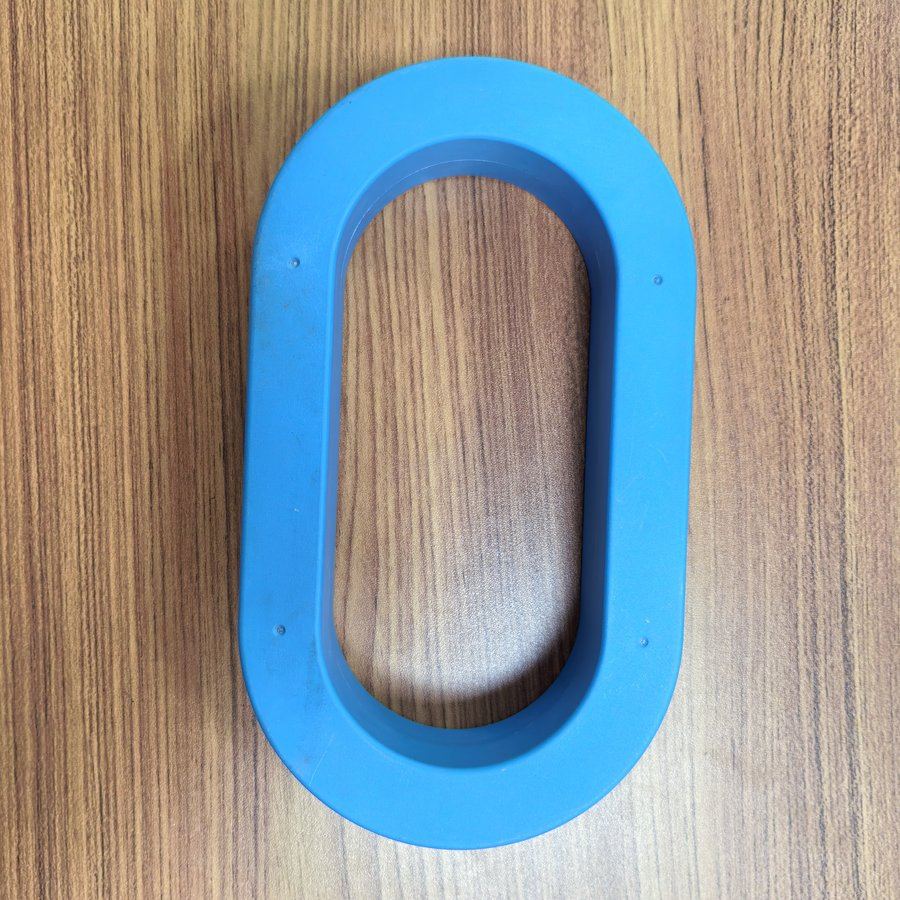
Oval/racetrack CMC — window and mold constraints beat round OD matching.
Unchanged: magnetic role. You still want a closed-path, high-μ CMC-oriented anneal for common-mode impedance, with canceling windings on line/neutral or dual DC rails. Bs ~1.2–1.25 T class, high initial μ (often discussed in the tens of thousands to >80,000 depending on grade and test), and finished assembly limits commonly about -40°C to +140°C still frame the conversation. Curie ~570°C keeps the alloy story viable when copper and case plastics limit continuous temperature.
Changed: mean magnetic path, local curvature, winding distribution, leakage, and mold interface. An oval is not a round toroid stretched in CAD. AL at a stated frequency depends on the real path and build; automatic winding tension and case tooling must match major/minor axes; overmold shrinkage can stress the coating if clearances are wrong. Treat oval/racetrack as a custom geometry family with its own FAIR and AL histogram—not a cosmetic outline on a round part number.
For classic round CMC sizing steps, keep using the CMC selection guide. For CM vs DM role split on the filter BOM: common mode vs differential mode choke. Do not press an inductor-oriented low-μ grade into an oval CMC cavity to “save SKUs”—the μ trap.
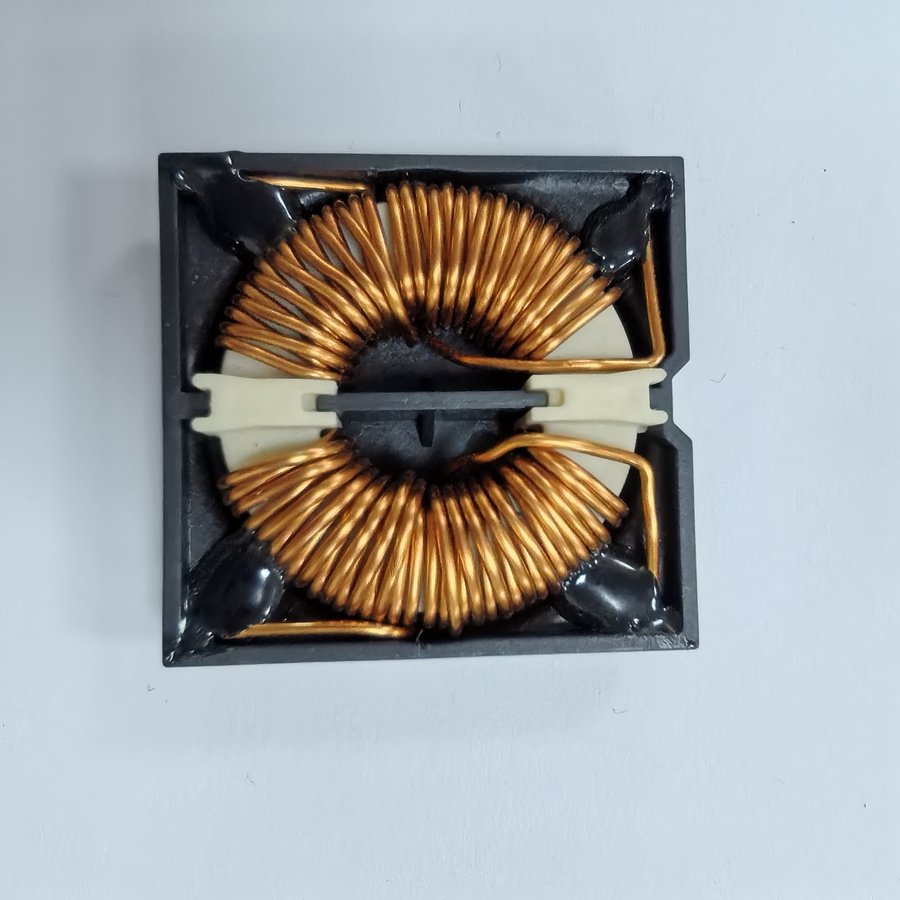
CMC family context — AL/Z at stated frequency still governs oval builds.
| Factor | Favor oval / racetrack | Favor round toroid |
|---|---|---|
| Envelope | Flat busbar channels, low height, dual-rail plastic modules | Cubic space available; standard cases in stock |
| Conductor path | Busbars or flat cables need elongated window | Round wire / twisted pairs fit circular ID |
| Tooling | Overmold / insert mold already frozen oval | No mold; hand or toroid winders preferred |
| Leakage / EMI | Manage lead dress carefully; elongated path can raise leakage | Often lower leakage if well wound and paired |
| Second source | Must match major/minor, build, radii, AL—mold fit critical | OD/ID/HT + AL/Z usually sufficient with case notes |
| Cost / lead time | Custom; pay for engineering correlation | Faster catalog-like iterations |
General nanocrystalline second-source discipline still applies—what VAC/Finemet-class buyers should freeze. Add geometry items round drawings often omit:
If ferrite was the old round part and heat or CM current forced nanocrystalline, read the material decision separately from the oval geometry decision—ferrite vs nanocrystalline for EMI/CMC. Open-path or poor lead dress still fails EMC regardless of outline—open magnetic path EMI signatures.
Paste-ready sketch for purchasing + engineering:
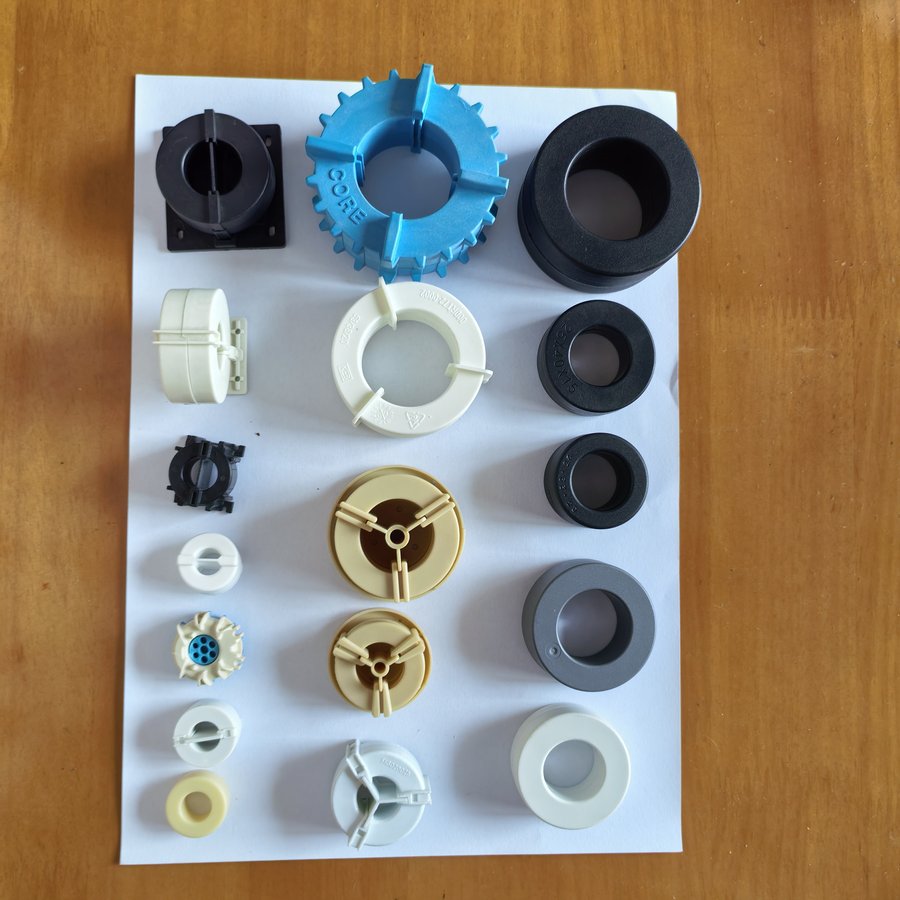
Cased line — freeze case type and lead egress for busbar/overmold programs.
“High-μ nanocrystalline CMC core, oval/racetrack geometry for CM impedance on [AC pair / DC rails]. Envelope: length ___, width ___, height ___, radii per attached DXF. Target AL or Z at ___ kHz / ___ excitation; fixture notes ___. Case/coating compatible with [overmold resin / clip]. Incumbent sample available for dimensional and AL correlation. Automotive: IATF scope + PPAP level ___. PCN required for anneal, ribbon insulation, and outline changes.”
Service-focused buyers pay for that correlation loop once. Skipping it to save piece price is how a dual-source program spends the savings on mold re-cuts and EMC retests.
Elongated windows change how copper fills the aperture. Turns tend to crowd on the long flats and thin out on the tight radii unless the winding house documents start/finish and layer rules. That imbalance raises leakage inductance and can convert differential energy into common-mode current on the harness—exactly the failure mode that looks like “need more Y-caps” on the LISN. Fix lead dress and symmetry first; only then raise AL or enlarge the core.
Production habits that keep oval CMCs stable:
Automotive and industrial modules that overmold the core should include a short pilot lot: dimensional FAIR, AL histogram, hi-pot if required, and a smoke EMI scan on the real busbar geometry. Hand-wired round prototypes do not predict molded oval behavior. When the incumbent was VAC/Finemet-class performance on a round CMC and the new package forces oval, treat material correlation and geometry correlation as two gates—pass both before dual-source SOP.
JP, DE/FR/IT, UK, US/CA, and RU high-spec programs usually optimize requalification risk, not gram price. An oval nanocrystalline CMC that misses mold clearance by 0.5 mm can idle a plastic tool for weeks. Budget engineering samples, FAIR, and EMI delta explicitly in the dual-source business case. Dongguan JH Amorphous expects joint reviews between purchasing and applications so piece price does not reopen EMC after the mold is cut. Related power-core context when the same platform also carries round CMCs or cut transformers: nanocrystalline cores for power applications.
Q1: Can I approximate an oval with a round core of equal Ae?
Magnetically rough, mechanically usually no. Mold fit, busbar clearance, and AL path length will not match. Design the oval properly.
Q2: Does oval geometry hurt CM impedance?
Not inherently if grade and winding are correct. Elongated paths can change leakage and local μ effective—validate Z and EMI on the assembled module.
Q3: What is the fastest way to fail an oval second-source trial?
Ordering by “similar nanocrystalline OD” without major/minor tolerances, radii, AL fixture notes, or mold clearance.
Q4: Are oval CMC cores always custom?
Usually yes at OEM volumes. Plan sample lead time and FAIR; do not assume catalog round lead times.
Q5: Should automotive oval CMCs follow the same PPAP habits as round ones?
Yes—plus dimensional special characteristics for the non-round envelope. AL and outline both belong in the control plan.
For oval/racetrack nanocrystalline CMC core reviews (mold match, AL correlation, EV busbar modules, dual-source samples), contact julia@amorphousoem.com — www.amorphousoem.com.
 Room 701, Jizhou Tongde Street 45, Shijie Town, Dongguan City, Guangdong Province, China
 +86-180 2701 0075
 sales@amorphousoem.com


 IPv6 network supported |
Sitemap
|
XML
|
blogs
|
Privacy Policy