Sep 24, 2026
When does ferrite fall off and nanocrystalline still hold?
High-temperature magnetics fail in two ways: the core’s permeability and saturation collapse as you approach the material Curie region, and the winding/case system exceeds insulation or solder limits. Mn-Zn ferrite commonly used in SMPS CMCs and transformers shows strong parameter derating in the ~100–120°C neighborhood familiar to power engineers, because its Curie point sits relatively low. Iron-based nanocrystalline cores, with Curie ~570°C and typical finished-case conversations often spanning about −40°C to +140°C, hold usable magnetic performance deeper into hot ambient and hot-spot maps—provided copper, plastics, and varnish are rated accordingly. Choose material by the real hottest-spot budget, not by room-temperature AL alone.
Temperature stack and material comparison
Datasheets quote ambient; failures happen at the hottest local temperature. A realistic stack for an EV charger OEM or industrial drive maker:
Ambient air or coolant inlet
Enclosure / cold-plate interface rise
Core surface / case temperature
Winding hotspot (often higher than core average)
Nearby power semiconductors adding heat
Ferrite vs nanocrystalline debates that only compare 25°C μ miss items 3–5. A ferrite CMC that meets insertion loss on a cool bench can lose impedance after soak in a sealed IP-rated box—the same pattern as our Italian 22 kW OBC case and German 800 V heavy-duty filter case.
ParameterMn-Zn ferrite (typical CMC/transformer)Iron-based nanocrystalline
Bs near room temp~0.4 T~1.25 T
Curie temperatureRelatively low (watch ~100–120°C class derating)~570°C
Finished core/case windowOften limited by μ/Bs collapse + plasticOften discussed −40°C to +140°C for cased parts
Design implicationUpsize or relocate when hotMagnetic headroom remains; manage copper/plastics
Why ferrite falls off near 100°C: As temperature rises toward its Curie region, Bs drops; permeability can rise then collapse depending on grade; inductance and impedance targets drift; saturation risk under the same ampere-turns increases. Designers compensate with larger cores, more parallel paths, forced air, or relocating the filter—each costly in automotive and dense industrial racks.
Symptoms of thermal magnetic derating: EMI that passes cold and fails after thermal soak; inductor current distortion that worsens when hot; protection trips on inrush only at elevated temperature. Always correlate with thermocouples on the core case and winding, not only chamber air.
Why nanocrystalline holds magnetically hotter: High Bs (~1.25 T class) for ampere-turn headroom; Curie ~570°C so the alloy is not near magnetic death at 120–140°C case temperatures; high-μ CMC grades (often ≈ 80,000–190,000 class) that keep CM impedance strong when ferrite has already surrendered margin.
The limiting parts of a nanocrystalline choke at high temperature are frequently enamel and interlayer insulation, case polymer continuous-use temperature, solder joints, and copper resistivity rise. “Nanocrystalline holds” means the magnetic function holds; thermal design of the assembly remains mandatory.
Cased nanocrystalline cores for elevated ambient—case and ribbon insulation share the thermal budget with copper.
Where the decision bites and how to select
Automotive OBC / DC-DC: Wide ambients; IATF 16949 sourcing expects temperature qualification. Nanocrystalline CMCs—see the JHNO EV CMC core family—are common when high current and hot EMI filters coincide.
Industrial drives and PV inverters: Cabinet hotspots above ferrite comfort zones appear near heatsinks and reactors. A material swap can restore EMI margin without enlarging the cabinet cutout.
Server / telecom PSU: Airflow is planned, but filter corners can still stagnate. Liquid-cooled platforms keep semiconductors happy while magnetics on the warm side of a cold plate still run hot—do not assume liquid cooling cools every toroid.
Selection process:
Map the hotspot with sensors at worst airflow.
Translate: Is the failure μ/Bs collapse (ferrite story) or copper/insulation (assembly story)?
Pick candidates: ferrite only if hotspot stays in its comfortable band; nanocrystalline when magnetic derating is the limiter.
Re-size copper for resistivity at temperature; check rise again.
Qualify cold too (−40°C class for automotive).
Document derating curves for PPAP/DFMEA when automotive.
Decision factorStay with ferriteMove to nanocrystalline
Hotspot modest, current modestOften OKOptional
Hot EMI fail after soakRiskyStrong candidate
High CM current + tight copperDifficultStrong candidate
Cost-only cool consumer SMPSOften winsMay be overkill
Automotive wide-temp + IATFPossible with careFrequently preferred for CMC
Test notes: Soak at temperature with power, not only oven preheat then quick test. Measure impedance/insertion loss hot when EMI is the requirement. For inductors, measure L vs I hot. Include humidity/bias if insulation resistance matters. Watch acoustic behavior hot and cold—damping changes.
Piece-price alone before thermal EMI failures is the wrong metric. Count validation days, shielding/capacitor overdesign, field-return risk, and cabinet volume. High-temperature magnetics is a system cost problem. Dongguan JH Amorphous (www.amorphousoem.com) manufactures OEM/ODM nanocrystalline and amorphous cores with ISO9001:2015 and IATF 16949 systems and helps buyers separate alloy capability from case/wire limits in RFQs.
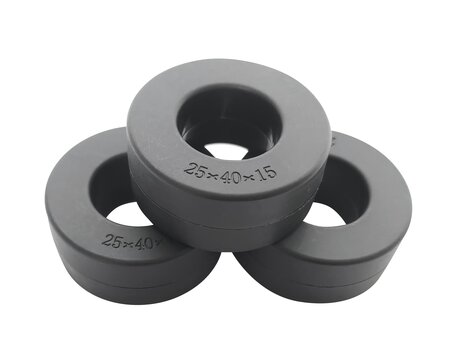
Assorted cased CMC sizes used in EV and industrial filters where ferrite μ has already rolled off.
FAQ
Q1: Does nanocrystalline never need derating?
It needs assembly derating. The alloy’s Curie (~570°C) is high, but wire, case, and PCB still limit continuous temperature. Typical finished-case discussions often reference about −40°C to +140°C depending on construction.
Q2: At what temperature should I stop using ferrite CMCs?
There is no single universal cutoff. When measured core temperature enters the zone where the chosen ferrite’s Bs/μ curves fall off sharply (often discussed near ~100–120°C class behavior), redesign or material change is warranted.
Q3: Will a bigger ferrite always fix heat derating?
Sometimes, at the cost of volume and copper. If ambient already sits near the ferrite problem region, size alone may not restore margin efficiently.
Q4: What data should I request from a core supplier?
Temperature-relevant AL or impedance notes, recommended case materials, insulation options, and automotive documentation path (IATF/PPAP) when needed.
Larger assemblies still rely on the same nanocrystalline Curie margin versus ferrite near 100°C.
Related reading
Italian EV OBC thermal & EMI case (54 mm nano)
German 800 V heavy-duty EV EMI case (JHNO71.5)
JHNO EV CMC core product page
Why traditional ferrite chokes fail at high frequency
If EMI or inductance drifts after thermal soak, share hotspot temperatures and filter targets with julia@amorphousoem.com — www.amorphousoem.com.
Read More

 Room 701, Jizhou Tongde Street 45, Shijie Town, Dongguan City, Guangdong Province, China
 +86-180 2701 0075
 sales@amorphousoem.com


 IPv6 network supported |
Sitemap
|
XML
|
blogs
|
Privacy Policy
IPv6 network supported |
Sitemap
|
XML
|
blogs
|
Privacy Policy